Shipping an Industrial Steam Boiler Overseas
Project Cargo Strategy
Moving a steam boiler is not standard freight; it is Project Cargo. This requires a bespoke movement method that begins long before the boiler leaves the factory floor. We focus on the unit's physical constraints and the legal frameworks governing its transit.
Technical Compliance: ASME and PED
Every boiler must meet the safety standards of the destination country. For North American exports, we verify ASME (American Society of Mechanical Engineers) compliance. For European movements, the PED (Pressure Equipment Directive) is the legal benchmark. You can find detailed technical guidance on pressure equipment safety via the UK Government website.
Incoterms 2020 and Risk Management
Choosing the correct Incoterms 2020 rule defines where the risk transfers from the seller to the buyer. For large industrial plant machinery, DAP (Delivered at Place) or DAT (Delivered at Terminal) are common, but many exporters prefer EXW (Ex Works) to limit their liability to the factory gate. You should consult the International Chamber of Commerce for the full definitions of these rules.
Marine Cargo Insurance
Standard carrier liability is rarely enough for high-value boilers. We recommend Institute Cargo Clauses (A). This provides the widest level of cover, protecting your investment against major casualties, theft, and heavy weather damage during sea freight transit.
Logistics Execution: From Factory to Port
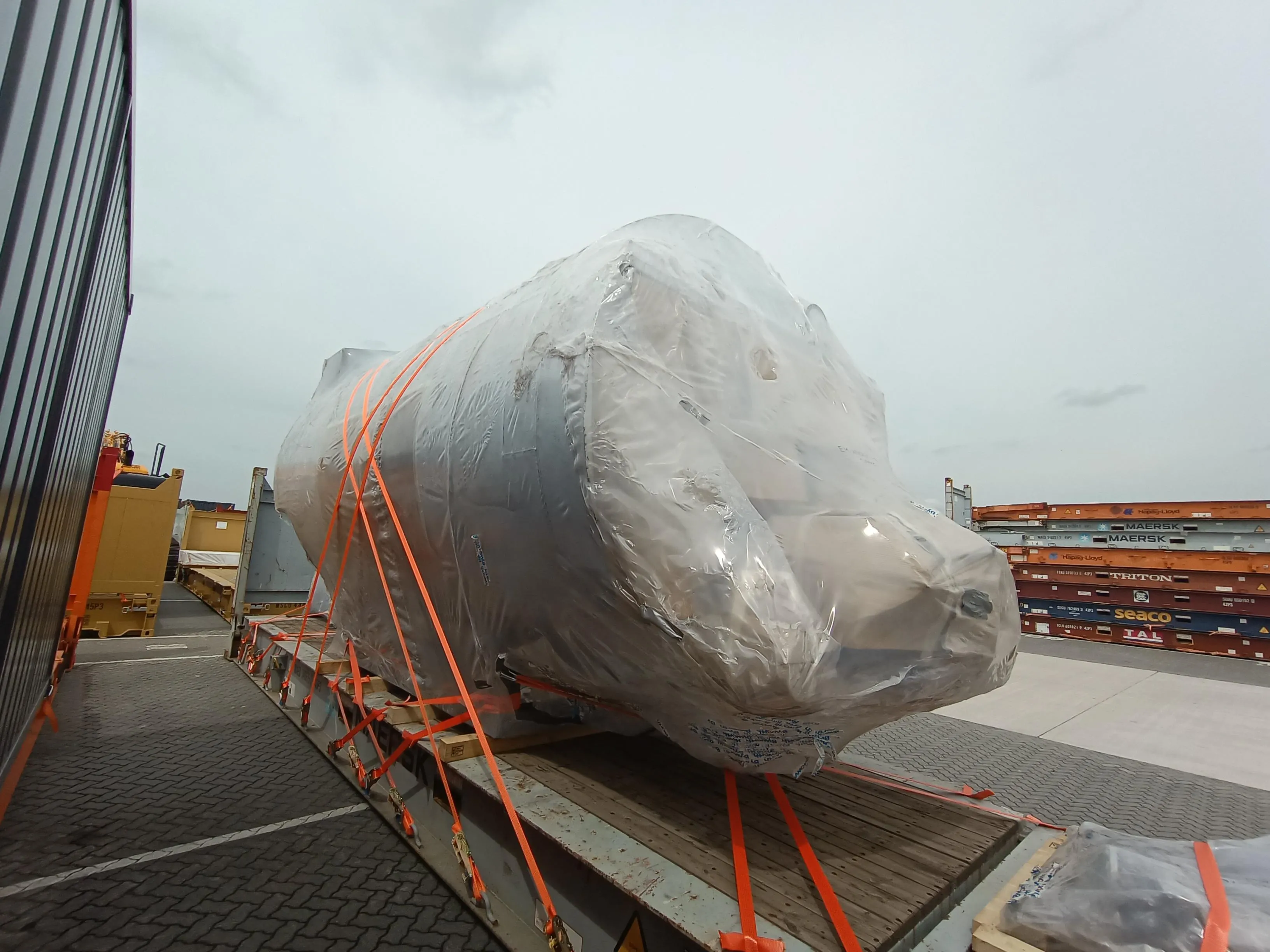
Boilers often exceed standard dimensions, requiring Out of Gauge (OOG) handling or Breakbulk shipping. We coordinate the Road Freight leg using low-loaders and modular transporters for extreme loads.
Verified Gross Mass (VGM)
Under SOLAS (Safety of Life at Sea) regulations, every shipper must provide a VGM. Inaccurate weight declarations can lead to stability issues on the vessel or fines at the port. We assist in obtaining weight certificates through either Method 1 (weighing the entire unit) or Method 2 (calculating the weight of all components and packaging).
Port Selection and Heavy Lift
Not every port can handle a 50-tonne boiler. We select gateways like the Port of Southampton or Felixstowe based on their heavy-lift crane capacity and proximity to the manufacturer. For movements to the United States, we often route via sea freight to the USA to utilise specialised roll-on/roll-off (RoRo) or lift-on/lift-off (LoLo) vessels.
Customs, Duties, and Documentation
Navigating customs clearance is the most common cause of delay. You must have a valid EORI number to export from the UK. Our team manages the following essential documents:
- Bill of Lading: The contract of carriage and title to the goods.
- Commercial Invoice: Must clearly state the HS Code for boilers (typically Chapter 84).
- MSDS: A Material Safety Data Sheet is required if the boiler contains residual chemicals or hazardous insulation.
- COO: A Certificate of Origin may be required to claim preferential duty rates under trade agreements.
For current UK export tariff information, refer to the British International Freight Association (BIFA) guidelines.
Managing Shipping Costs
The total cost includes more than just the freight rate. We provide transparent breakdowns of:
- BAF: Bunker Adjustment Factor (fuel surcharges).
- Demurrage and Detention: Fees incurred if the boiler or container stays at the port longer than the agreed free period.
- Lashing and Securing: The cost of welding D-rings or building timber cradles to secure the boiler on deck.
Expert Logistics FAQ
What is the difference between FCL and Breakbulk for boilers?
FCL (Full Container Load) is used if the boiler fits inside a 40ft High Cube or on a Flat Rack. Breakbulk is for oversized units that are loaded directly onto the vessel deck because they exceed container dimensions.
Do I need a police escort for road transport to the port?
Escorts are required if the boiler width exceeds 3.5 metres or the weight exceeds specific axle limits. We manage all abnormal load permits and police notifications on your behalf via our road freight department.
How is VAT handled on exports?
Exported goods are typically zero-rated for VAT in the UK, provided you maintain Evidence of Export, such as the Departure Message (S8) from the Customs Declaration Service.
Can you ship boilers to the Middle East?
Yes. We provide dedicated sea freight to the UAE and other regional hubs, ensuring all local certificates of conformity are in place before the vessel arrives.